Friday, 23 October 2026 · 5 videos and 7 articles from 22–23 Oct, merged into 5 stories
TL;DR
1Highlight: AI found a critical hole in PHP, and the coordinated patch for every PHP 8.x version is out. Update now.
2Personal agents are taking off, from Muse to Claude Duet, and the first sharing-link leaks show why settings matter.
3Claude-designed proteins passed a lab test, TimesFM 3.0 shows forecasting's limits, and Agent Skills joins MCP as an open standard.
Highlight of the day
AI security
PHP 8.x
every supported version needed the patch
Merged from 3 sources
★ Highlight of the day
AI found a critical hole in PHP, and the coordinated patch is out: update now
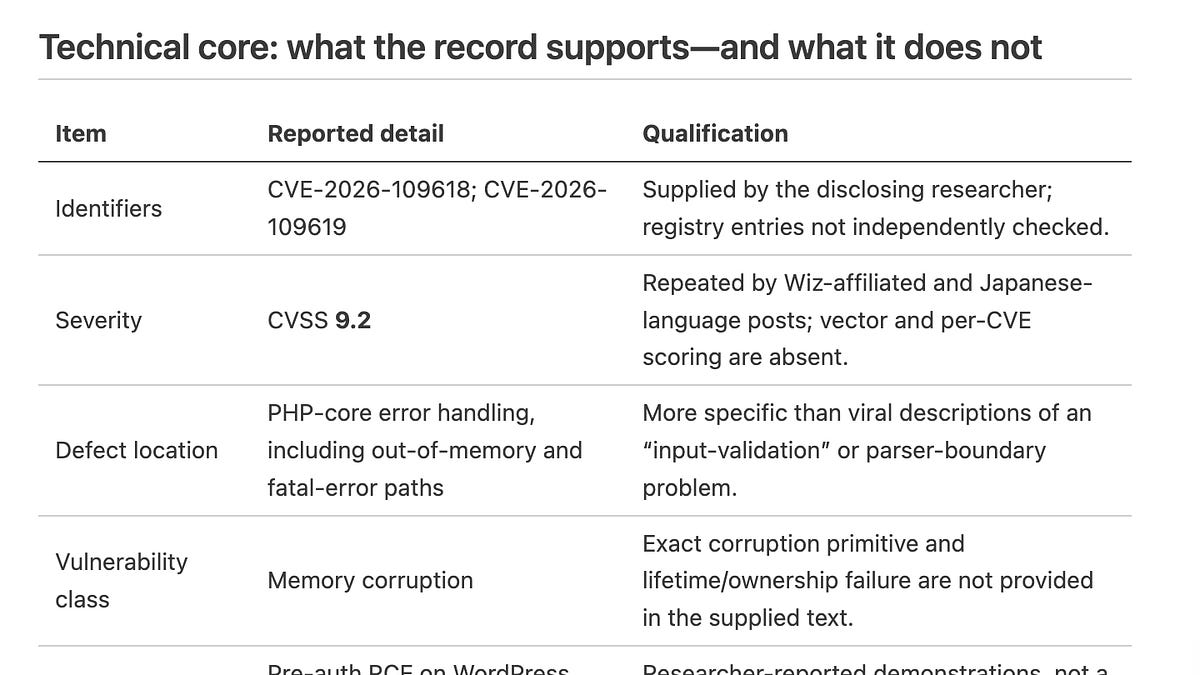
Two memory-corruption bugs in the PHP engine, nicknamed PHP2Shell, were found separately by a researcher using OpenAI's Patch the Planet program and by Wiz Research using frontier models. Researchers showed remote code execution on WordPress, Drupal and Joomla before login. After about two months of coordination, patched PHP 8.x releases shipped on Oct 21, a day early because the CVE IDs leaked.
What we learned
The patches cover the whole PHP 8.x line; Cloudflare shipped stopgap firewall rules for every plan while sites update.
The release was pulled forward after the CVE IDs leaked with a wrong severity score (10.0 instead of 9.2), and a mistakenly published proof-of-concept video sped up exploit work.
OpenAI published a Codex Skill A saved, reusable set of instructions (and sometimes code) that an AI agent loads when a task needs it. that walks site owners through checking exposure, a helper rather than a substitute for vendor advisories.
Credit is disputed, and viral outage claims are uncorroborated: "All high profile cyber disclosures are at least a little bit of marketing."
Why it matters: Any client site on WordPress, Drupal or Joomla should be patched now, and asking a coding agent to scan your own projects for affected dependencies is a quick first check.
Personal agents are taking off, and the first leaks show why sharing settings matter
Meta's Muse passed 10 million US downloads in 40 days, but researchers found thousands of shared conversations through guessable share links and Meta pulled the feature. Anthropic's Claude Duet is in US-only preview and Gemini in Android Auto now taps your Google data. Riley Brown argues the best use of agents is removing clutter rather than creating it.
Key learnings
About 6,800 Muse shared-conversation links were enumerable because the URLs were guessable; Meta removed sharing while it hardens it.
Gemini in Android Auto can now use your inbox and other Google data, for example to check whether you'll make a flight.
Examples shown: debloating smart TVs and an e-reader with Claude Code, letting an agent archive obvious spam, and replacing single-purpose apps with a prompt plus a spreadsheet.
A Muse automation that logs new followers to a spreadsheet and flags relevant ones is a simple pattern for social monitoring.
Why it matters: Before rolling an assistant out to a team, check how its sharing links and data access work; the useful wins are small automations that remove busywork.
Claude-designed proteins bound scorpion toxins in the lab, but the slow part is still the lab
A research firm used Claude with 300 subagents to generate 318,000 protein-binder candidates, tested 211, and an independent lab confirmed 17 bind to four scorpion neurotoxins. None has been shown to neutralise venom yet, and critics note binders were shown before. OpenAI is also pushing into life sciences by acquiring Orchestra Bio for its GPT Rosalind tools.
Key learnings
17 of 211 Claude-designed binders met the experimental binding criteria.
Dry-lab design took about 64 hours, while lab results took 39 days and a release would take 4 to 7 years.
OpenAI's GPT Rosalind and Workbench agents are positioned as tools for existing pharma companies.
AI lets firms do research outside their field that can sharpen their core work.
Why it matters: AI speeds up the thinking step, but timelines are still set by the physical steps; plan projects around the real bottleneck.
lower error than a seasonal baseline in the transit test
Merged from 3 sources
Models & infrastructure
Forecasting models, inference basics and elastic GPUs: what actually runs AI
Google's TimesFM 3.0 forecasts well out of the box but can only extrapolate levers that have moved in your history. IBM explains why serving a model costs more than training it over time. Modal's CEO argues GPU A powerful computer chip, originally for graphics, that is now the main hardware used to train and run AI. demand is spiky, so capacity should be pooled and elastic, with sandboxes for coding agents now a big part of its business.
Key learnings
TimesFM 3.0 handles holidays and promotions inside the model, but mis-judged a 'double the marketing spend' what-if; 3.0 weights are non-commercial to self-host while 2.5 is Apache 2.0.
Prefill reads the whole prompt and is compute-bound; decode writes one Token A small chunk of text, roughly part of a word, that AI models read and write. AI usage and pricing are counted in tokens. at a time and is memory-bound. They map to time-to-first-token and inter-token latency.
Inference engines like vLLM, Ollama and llama.cpp mostly expose OpenAI-compatible endpoints, so models can be swapped without rewriting code.
Modal's fast startup comes from GPU memory snapshots, checkpointing and a custom filesystem.
Why it matters: When a client asks for AI forecasts or self-hosted models, check the license and whether their history contains the decision they want to test.
Google's TimesFM 3.0: Is This The End of Traditional Forecasting? · Prompt EngineeringWatch ↗
What Is LLM Inference? How AI Models Generate Responses · IBM TechnologyWatch ↗
Why AI Compute Comes in Rectangles — Erik Bernhardsson, Modal CEO · Latent SpaceListen ↗
Standards & dev culture
Merged from 4 sources
Standards & dev culture
Agent Skills becomes an open standard next to MCP, while developers laugh at AI coding culture
Anthropic donated Agent Skill A saved, reusable set of instructions (and sometimes code) that an AI agent loads when a task needs it. to the Agentic AI Foundation, the Linux Foundation group that already hosts MCP. Fireship's satire of 2026 coder types lands on real problems: insecure vibe-coded apps and maintainers swamped by AI pull requests. A Latent Space interview argues small AI teams have to own everything themselves.
Key learnings
The Agentic AI Foundation was co-founded with Block and OpenAI, so skills and MCP now sit under one neutral home.
Simon Willison found his own earlier prediction of this by asking Claude to search his blog through datasette-mcp.
Security basics still matter for AI-built apps: hard-coded API keys on the front end are a recurring failure.
"You are the team": trusted sources, solid document extraction and meeting users before hiring matter most.
Why it matters: Skills written today should keep working across tools as the standard spreads, which makes them a safer investment for client playbooks.
 AI security